Drone License Cost in 2026: Every Fee and Expense Explained
One of the most common questions from aspiring commercial drone pilots is straightforward: how much does it cost to get a drone license? The good news is that the FAA Part 107 Remote Pilot Certificate is one of the most affordable professional certifications you can earn. The total cost ranges from $175 to $475 depending on what study materials you choose, and the certificate itself is free from the FAA once you pass the knowledge test.
This guide breaks down every cost associated with getting and maintaining your Part 107 drone license in 2026, including the fees most guides forget to mention. By the end, you will know exactly what to budget and where you can save money without sacrificing your chances of passing.
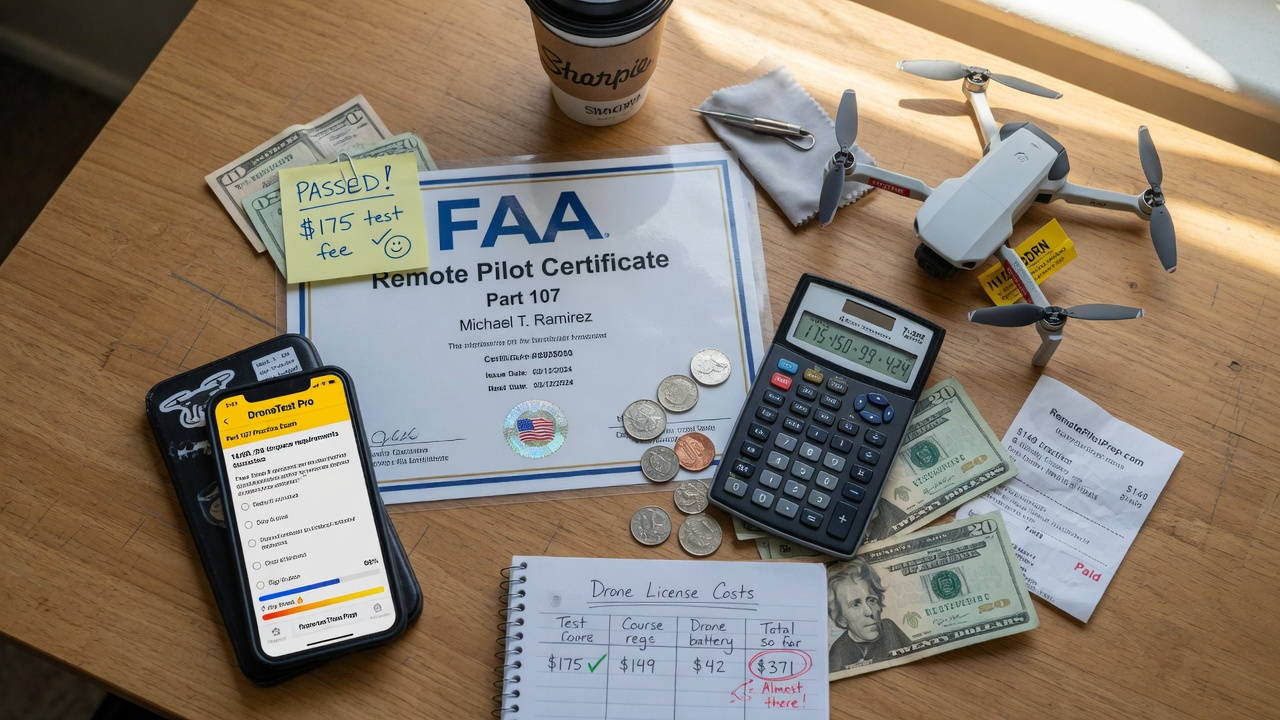
Total Cost Summary
Here is the quick overview before we break down each line item:
- FAA Part 107 Knowledge Test fee: $175 (required)
- Study materials: $0 to $300 (varies by choice)
- Remote Pilot Certificate: Free from the FAA
- Total to get certified: $175 to $475
That is it for the certification itself. However, there are additional costs for actually operating as a commercial drone pilot that you should budget for, which we cover in detail below.
The FAA Knowledge Test Fee: $175
The single required cost for earning your Part 107 drone license is the FAA Unmanned Aircraft General knowledge test fee of $175. This fee is paid directly to PSI, the testing company that administers FAA knowledge tests at their testing centers nationwide. You pay the fee when you schedule your exam appointment through PSI's website at psiexams.com.
Important details about this fee:
- It is non-refundable. If you do not show up for your appointment or if you fail the test, you do not get the $175 back. This is a good reason to make sure you are thoroughly prepared before scheduling your exam.
- It is per attempt. If you fail and want to retake the test, you will pay another $175. You must wait 14 days between attempts. This makes failing expensive, which is all the more reason to invest in proper study materials upfront.
- No additional fees to the FAA. Unlike some certifications that charge a separate application fee, the FAA does not charge anything beyond the PSI testing fee. Once you pass, you apply for your Remote Pilot Certificate through the FAA's IACRA system at no cost.
Study Material Costs: $0 to $300
Study materials represent the biggest variable in your total cost. You have options at every price point, and more expensive does not necessarily mean better preparation.
Free Study Resources
The FAA provides several free resources that cover all testable material:
- FAA Remote Pilot Study Guide (FAA-G-8082-22): The official study guide from the FAA covers every topic on the exam. It is dense and reads like a government document, but the information is comprehensive and authoritative.
- FAA Airman Certification Standards (ACS): This document outlines exactly what knowledge areas and skill levels the exam tests. It is essentially the exam blueprint.
- YouTube tutorials: Several aviation educators publish free Part 107 study content on YouTube. The quality varies, but channels dedicated to drone certification tend to cover the material thoroughly.
- FAA Safety Team (FAASTeam) webinars: The FAA occasionally offers free webinars on topics relevant to the Part 107 exam.
The free path works, but it requires more self-discipline and organization. You will need to structure your own study plan, find your own practice questions, and piece together resources from multiple sources. For motivated self-starters with the time to curate their own curriculum, the free approach can absolutely get you to a passing score.
Paid Study Options ($50 to $300)
Paid study resources offer structured learning paths, practice tests, and time savings. Here is what the market looks like in 2026:
- Online video courses ($100 to $300): Companies like Pilot Institute, Drone Launch Academy, and DARTdrones offer comprehensive video-based courses. These typically include hours of video instruction, practice tests, and sometimes a money-back pass guarantee. They are thorough but represent the highest price point.
- Study apps ($10 to $50): Mobile apps offer the most convenient study format with flashcards, practice questions, and progress tracking. The Flycensed app provides 485 flashcards with spaced repetition, 201 practice questions, and METAR decoder tools, giving you everything you need for test prep at a fraction of the cost of video courses.
- Practice test subscriptions ($20 to $50): Some platforms offer banks of practice questions modeled after the real exam. Practice testing is one of the most effective study methods, so this can be money well spent.
- Study guide books ($15 to $40): Printed or digital study guides from publishers like ASA provide structured content in a traditional format. These work well for people who prefer reading over video or app-based learning.
The sweet spot for most candidates is spending $30 to $75 on a quality app or practice test resource. This gives you the structure and practice questions you need without the premium price of full video courses. Combined with free FAA resources, this approach covers all your bases.
The Remote Pilot Certificate: Free
Here is a fact that surprises many people: the Part 107 Remote Pilot Certificate itself costs nothing. After you pass the knowledge test, you apply through the FAA's Integrated Airman Certification and Rating Application (IACRA) system online. The FAA processes your application and issues your temporary certificate electronically, and your permanent certificate arrives by mail. There is no application fee, no certificate fee, and no issuance fee. The $175 knowledge test fee is the only payment the FAA requires.
Your Remote Pilot Certificate does not expire, but it does require renewal every 24 months through a recurrent knowledge assessment, which we cover next.
Renewal Costs: Free (Every 24 Months)
To maintain your Part 107 privileges, you must complete a recurrent knowledge assessment every 24 months. As of 2026, the FAA offers the recurrent training and assessment online through the FAA Safety Team (FAASTeam) WINGS program at no cost. You complete a series of training courses and pass an online knowledge assessment, and your certificate is renewed.
It is worth noting that the FAA has discussed potential changes to the recurrent testing process, including the possibility of requiring in-person testing at a PSI center for some renewal scenarios. As of April 2026, the online free renewal process remains the standard pathway for most Part 107 holders. If you initially earned your certificate through the knowledge test at a PSI center, your recurrent assessment is done online at no cost. Keep an eye on FAA announcements for any future changes to this process.
Hidden Costs Most Guides Do Not Mention
Getting your Part 107 certificate is just the beginning. If you plan to operate commercially, there are additional costs that you should factor into your budget.
Drone Registration: $5 Per Drone
Every drone you fly commercially must be registered with the FAA through the FAADroneZone portal. Registration costs $5 per drone and is valid for 3 years. This applies regardless of the drone's weight, as long as it weighs more than 0.55 pounds (250 grams), which covers virtually all commercial drones. If you operate multiple drones, each one requires its own registration.
Liability Insurance: $500 to $1,000 Per Year
Liability insurance is not legally required by the FAA for Part 107 operations, but it is effectively mandatory for professional work. Almost every commercial client will require proof of insurance before hiring you. Most contracts specify a minimum of $1 million in liability coverage.
Annual drone liability insurance policies typically cost $500 to $1,000 per year depending on your coverage limits, the type of work you do, and your claims history. Some providers also offer per-flight or monthly policies if you do not fly frequently enough to justify an annual premium. Companies like SkyWatch, Thimble, and Verifly are popular options in the drone insurance market.
Remote ID Compliance: $0 to $100
All commercial drones must comply with FAA Remote ID requirements. If you purchased your drone after September 2022, Remote ID is almost certainly built into the firmware at no additional cost. If you fly an older drone that does not have built-in Remote ID, you will need to purchase an FAA-approved Remote ID broadcast module, which typically costs $30 to $100 depending on the manufacturer and model.
Equipment Costs (Practical, Not Required)
While not a licensing cost, the practical expenses of commercial drone operations add up. A professional-grade drone suitable for commercial work runs $1,000 to $5,000 or more. Extra batteries ($50 to $200 each), a quality carrying case ($100 to $300), and ND filters or other accessories add to the total. These are business investments rather than licensing fees, but they are worth budgeting for if you are planning a commercial operation.
Cost Comparison: Part 107 vs. Other Professional Licenses
To put the Part 107 cost in perspective, here is how it compares to other professional certifications:
- Part 107 drone license: $175 to $475 total
- Private Pilot License (manned aircraft): $10,000 to $15,000
- Real estate license: $500 to $1,500 (varies by state)
- Commercial Driver's License (CDL): $3,000 to $7,000
- Project Management Professional (PMP): $555 to $1,500
- Certified Public Accountant (CPA): $2,000 to $5,000
The Part 107 certificate is one of the most affordable professional credentials available. For under $500, you gain the legal ability to earn money flying drones, which is a remarkable value proposition compared to almost any other professional certification.
Return on Investment: How Quickly Does It Pay Back?
The ROI on a Part 107 certification is compelling. Commercial drone pilots charge $50 to $150 per hour depending on the type of work and their experience level. Common commercial drone services and their typical rates include:
- Real estate photography and video: $150 to $500 per property
- Roof and building inspections: $100 to $300 per inspection
- Construction site mapping: $200 to $500 per flight
- Event coverage: $200 to $1,000 per event
- Agricultural surveys: $10 to $25 per acre
Even at the lowest end of the rate scale, a single commercial job can cover your entire certification cost. Most Part 107 pilots recoup their investment within their first one to three jobs. Few professional certifications offer that kind of payback timeline.
The Budget-Friendly Path to Certification
If you want to minimize your out-of-pocket costs while still maximizing your chances of passing, here is the approach we recommend:
- Study materials: Use the free FAA study guide for foundational content. Supplement with the Flycensed app for flashcards with spaced repetition, practice questions, and METAR tools. This combination gives you comprehensive coverage at minimal cost.
- Practice tests: Take as many practice tests as possible before scheduling your exam. The Flycensed app includes 201 practice questions that you can use for targeted study and full-length simulated tests.
- Schedule your exam only when ready: Since the $175 test fee is non-refundable and per-attempt, do not schedule until you are consistently scoring 85 percent or higher on practice tests. Failing and retaking costs you an extra $175 and two weeks of waiting.
- Total minimum cost: $175 for the exam plus a low-cost study app. That is it.
What You Get for Your Money
For $175 to $475, you receive a federal certification that authorizes you to operate drones commercially anywhere in the United States. Your Part 107 Remote Pilot Certificate never expires as long as you complete the free recurrent assessment every 24 months. There are no annual licensing fees, no membership dues, and no continuing education costs beyond the free renewal. It is a one-time investment that opens the door to a rapidly growing industry.
The commercial drone services market continues to expand as more industries adopt drone technology for inspections, mapping, photography, agriculture, and dozens of other applications. Getting certified now positions you to take advantage of this growth, and the barrier to entry has never been lower.
Ready to invest in your drone career? Download Flycensed for free and start preparing for the Part 107 knowledge test today. With 485 flashcards, 201 practice questions, and built-in METAR tools, it is everything you need to pass your exam and get certified at the lowest possible cost.