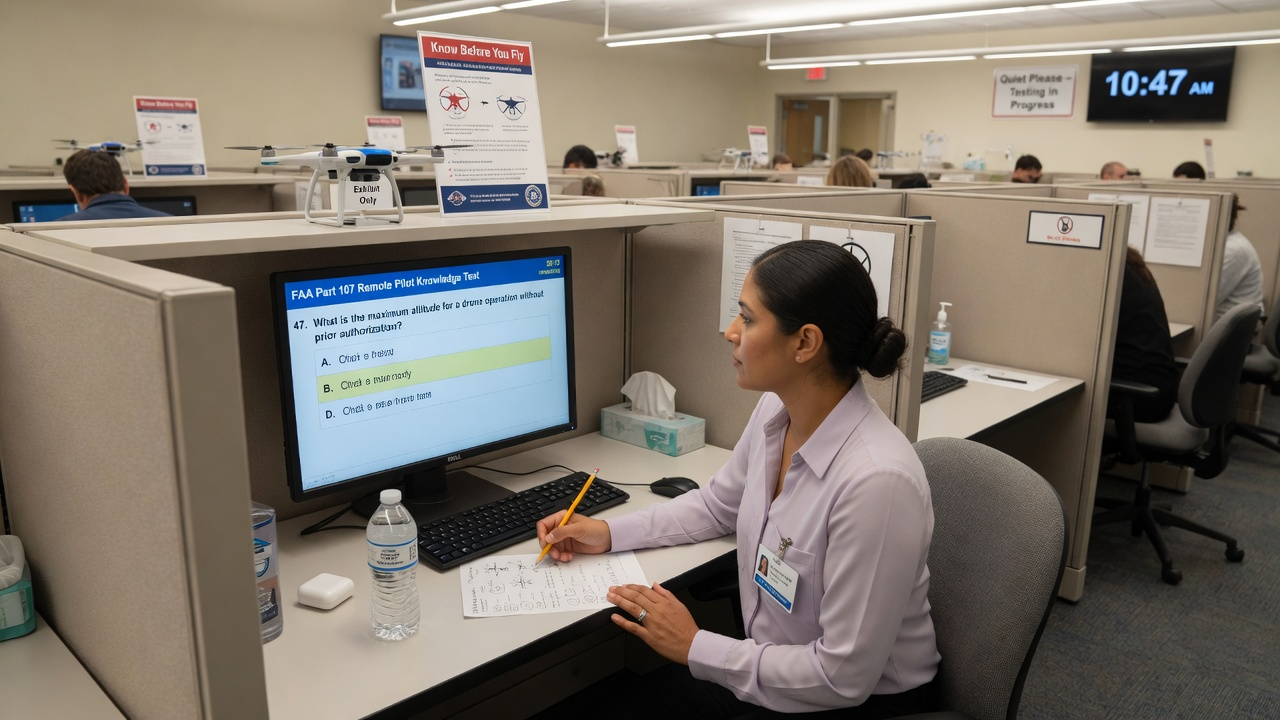
You walked out of the testing centre with a number below 70 and a sheet of paper you have not really looked at yet. The immediate question is not whether you can try again. It is how long, how much, and how much of the paperwork you have to do over.
The good news is that the administrative answer is very short.
14 CFR § 107.71, in full — this is the entire section: "An applicant for a knowledge test who fails that test may not reapply for the test for 14 calendar days after failing the test."
That is the whole rule. There is no appeal, no remedial course requirement, no form to file, and nothing in the regulation limiting how many attempts you get. Fourteen calendar days, then you may book again.
Calendar days, which is worse than it sounds
Calendar days include weekends and holidays, which cuts both ways. It means the clock does not pause — but it also means the fourteenth day can land on a Saturday when your testing centre is shut, and the practical wait becomes sixteen or seventeen days. If you are working to a client deadline, count forward on an actual calendar and check the centre's opening days before you promise anyone a date.
What you do not have to do again
This is where most of the anxiety turns out to be misplaced. A failed knowledge test does not undo the setup work around it.
- Your FAA Tracking Number stands. The FTN you created in IACRA before booking is permanent and identifies you across every attempt. You do not create a second one, and creating a duplicate account is the one genuinely damaging mistake available here.
- Your registration stands. Aircraft registration is separate from pilot certification and is unaffected by the test result.
- Nothing carries a penalty forward. A failure is not recorded against you in a way that raises the bar on the next attempt. The passing standard is the same 70 percent it was the first time.
What you do repeat is the booking and the fee. The exam fee is charged in full for every attempt — there is no reduced rate for a retake. Budget for that before you rebook rather than after.
Read the report before you open a study guide
The single most common error after a failure is going back to the beginning and re-reading everything. That is expensive in time and tends to reinforce what you already knew rather than fixing what you did not.
Your test report identifies the knowledge areas where you performed poorly. Work from that outward. In practice the failures cluster into a small number of areas, and our breakdown of the five topics that trip up most drone pilots is a reasonable place to check your weak areas against.
Two areas are worth singling out because they are learnable in a way that raw regulation memorisation is not:
- Sectional charts. These are a skill, not a fact set — you get better by reading charts, not by reading about charts. Start with our guide to reading sectional charts and then work real ones.
- Weather products. METARs look impenetrable until the encoding clicks, and then they are close to free marks. Our METAR walkthrough exists for exactly this.
If your report points at airspace instead, that is a chart-reading problem wearing a different hat, and the same fix applies.
Use the fourteen days as a structure, not a sentence
Two weeks is close to ideal for targeted repair work, and it is long enough that drifting is a real risk. A workable shape:
- Days 1 to 2 — go through the report and write down every flagged area. Do no studying yet. You are building a list, not revising.
- Days 3 to 9 — one area per session, worst first. Practice questions after each, not before, so you are testing recall rather than recognition.
- Days 10 to 12 — full-length practice tests under timed conditions. The clock is part of the exam and people who study untimed lose marks to it.
- Days 13 to 14 — light review only, and rebook. Do not learn new material in the last 48 hours.
If you would rather follow something already sequenced, our 30-day study plan compresses sensibly into two weeks when you are only repairing specific areas rather than starting cold.
Rebooking
Once the fourteen days have elapsed you schedule another appointment the same way you did the first one, and you will need photo identification again. Our guide to where to take the Part 107 exam covers the booking mechanics and the identification rules, including the ordering trap that catches first-timers.
One thing that has not changed and is worth re-reading before you sit down: results take up to 48 hours to appear in IACRA, and the TSA security check gates the temporary certificate after that. Passing is not the last step.
What we could not confirm
- We could not confirm the current exam fee from an FAA page. The figure is set by the testing provider and has moved over time; check it at booking rather than trusting any article, including ours. Our cost breakdown carries the figure we last verified, with the same caveat.
- § 107.71 sets no maximum number of attempts and we found nothing elsewhere in Part 107 that does. We could not confirm whether any testing provider imposes its own limit.
- We could not confirm the current format and exact content of the test report from a primary source. It identifies weak knowledge areas; the coding scheme used to do that has changed over the years.
- The study schedule above is our suggestion, not an FAA recommendation. Nothing in the regulation requires you to study at all during the fourteen days.
- Whether a failure is visible to anyone else — an employer, an insurer — is outside anything we can source. The regulation is silent on it.
The short version
Fourteen calendar days from the date you failed, then you may reapply. Count them on a real calendar, because the fourteenth day can land when the centre is closed. Your FTN, your IACRA account and your registration all survive; the fee does not, and you pay it again in full. Read the report before you read anything else and fix only what it points at — charts and weather are the two areas that reward practice most and are the most common reasons people are reading this at all. There is no cap on attempts, and a failure changes nothing about the standard you face next time.
The most efficient repair work is question practice in the areas your report flagged. The Flycensed iOS app is free and has 485+ practice questions, and the Part 107 Practice Exams give you full-length timed papers for the last stretch before you rebook.
Study and flight-bag gear
Affiliate links — we may earn a commission from purchases at no extra cost to you. We only list gear we would actually put on a job.
- Scotch Laminating Pouches, letter, 5 mil (100) — Laminate the handful of tables you keep getting wrong and put them somewhere you will walk past.
- ASA VFR Kneeboard (KB-1) — Useful after you pass, and useful now for timed practice at a desk that looks like the real thing.
- Rite in the Rain Weatherproof Copier Paper (letter) — Print sectional excerpts and mark them up properly; chart reading improves with a pencil in your hand.