Is the Part 107 Test Hard? An Honest Assessment for 2026
If you are considering getting your commercial drone license, the question burning in your mind is probably this: is the Part 107 test hard? The honest answer is that it is moderately difficult. It is not a test you can walk into cold and expect to pass, but it is absolutely not the kind of exam that should intimidate anyone willing to put in a few weeks of focused preparation. Thousands of people pass the Part 107 knowledge test every month, and with the right study approach, you can be one of them.
This guide gives you a complete, no-nonsense breakdown of what makes the test challenging, what the pass rates actually look like, exactly what you will face on exam day, and the study strategies that give you the best chance of passing on your first attempt.
Part 107 Pass Rates: What the Numbers Tell Us
Let's start with the data. The overall pass rate for the FAA Part 107 Unmanned Aircraft General knowledge test hovers around 70 percent across all test-takers. That number includes people who walked in with minimal preparation, people retaking the test after a previous failure, and people who studied extensively. It is not a particularly useful number on its own.
The more meaningful statistic is the first-attempt pass rate among candidates who followed a structured study plan. That number climbs to approximately 90 percent. The gap between 70 percent overall and 90 percent for prepared candidates tells you everything you need to know: this test rewards preparation, and the people who fail are overwhelmingly those who underestimated what was required.
For context, the Part 107 pass rate is significantly higher than many other FAA knowledge tests. The Private Pilot knowledge test has a first-attempt pass rate closer to 80 percent, and the Instrument Rating test sits around 75 percent. The Part 107 exam is designed for a broader audience, and the FAA structured it accordingly.
Test Format: Exactly What You Will Face
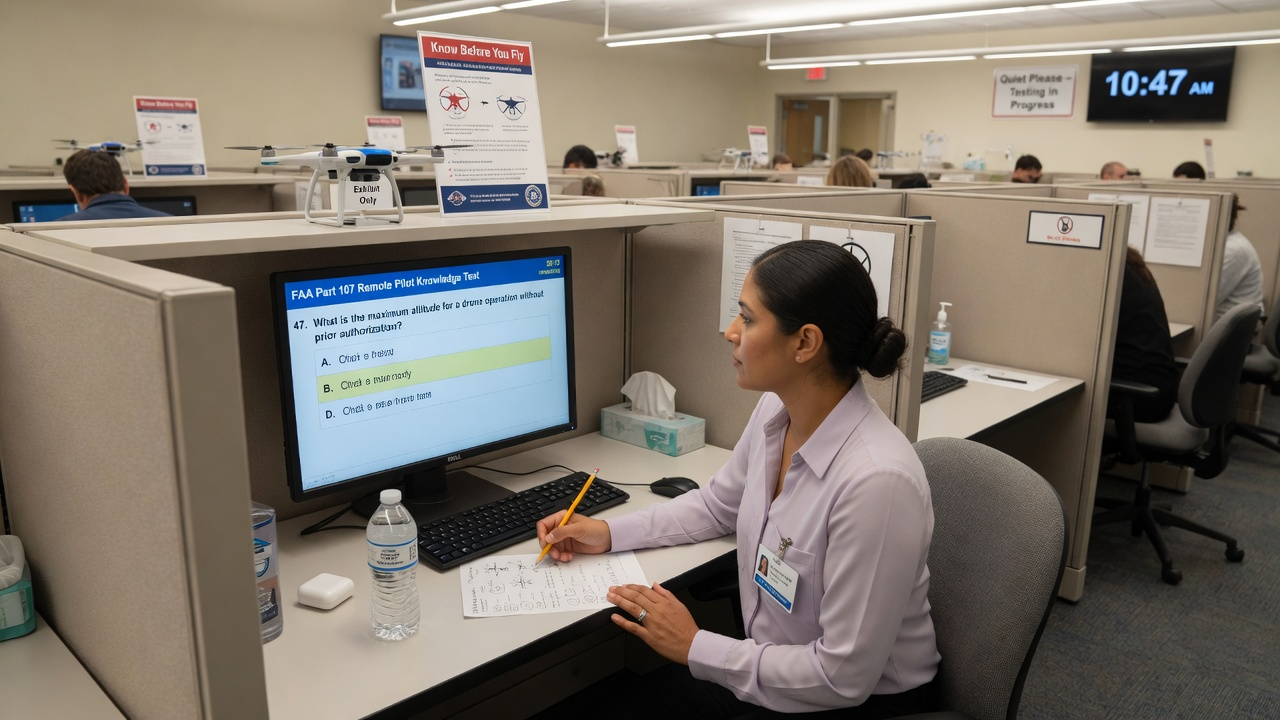
Understanding the format removes a lot of the anxiety. Here is exactly what the Part 107 knowledge test looks like:
- Number of questions: 60 multiple choice questions
- Time limit: 120 minutes (2 hours)
- Passing score: 70 percent, which means you need at least 42 out of 60 correct answers
- Question format: Each question has three answer choices (A, B, or C), not four
- Testing location: PSI testing centers nationwide (find one at psiexams.com)
- Cost: $175 non-refundable exam fee
- Resources provided: You will receive a testing supplement with sectional chart excerpts, airport diagrams, and weather reports that some questions reference
The 120-minute time limit is generous. Most candidates finish in 60 to 90 minutes, leaving plenty of time to review flagged questions. Time pressure is not a factor for the vast majority of test-takers.
The three-choice format actually works in your favor compared to four-choice exams. Even on questions where you are uncertain, you have a 33 percent chance of guessing correctly, and if you can eliminate even one obviously wrong answer, your odds jump to 50 percent.
The Five Main Topic Areas (and Which Are Hardest)
The Part 107 knowledge test draws questions from five major subject areas. Not all areas are equally difficult, and knowing where to focus your study time makes a significant difference.
1. Airspace Classification and Requirements (Hardest)
This is consistently the topic area that trips up the most candidates. You need to understand the six classes of airspace (A, B, C, D, E, and G), know their dimensions and altitude boundaries, recognize them on sectional charts, and understand what authorizations you need to operate in each. Questions often present a sectional chart excerpt and ask you to identify what class of airspace covers a specific location, or whether you need ATC authorization to fly there.
What makes it hard is the visual interpretation component. Reading sectional charts is a learned skill, and the color-coded boundaries, dashed versus solid lines, and altitude notations require practice to read quickly and accurately. If you have never looked at a sectional chart before, this will feel foreign at first. But the system is logical once you learn the conventions, and pattern recognition develops quickly with practice.
2. Weather and METAR Reports (Second Hardest)
Weather questions cover two distinct skill sets. First, you need to understand how weather conditions affect drone operations: wind effects, visibility minimums, cloud clearance requirements, and weather phenomena like thermals, microbursts, and density altitude. Second, you need to decode METAR reports, which are coded weather observations that look like gibberish until you learn the format.
A METAR like "KDEN 211753Z 27012G20KT 10SM FEW080 SCT120 BKN200 24/08 A3012" contains wind speed and direction, visibility, cloud layers, temperature, and barometric pressure. The exam will give you a METAR and ask you to extract specific information from it. This is pure memorization and pattern recognition, and it responds very well to practice.
3. Regulations and Operating Rules (Moderate)
This section covers the actual Part 107 regulations: maximum altitude (400 feet AGL), visual line of sight requirements, operating near airports, right-of-way rules, alcohol restrictions, accident reporting requirements, and waiver procedures. The material is straightforward but there is a lot of it. Most questions are factual recall rather than interpretation, so thorough reading and flashcard review work well here.
4. Aircraft Performance and Loading (Moderate)
Performance questions address how factors like weight, temperature, altitude, and wind affect your drone's capabilities. You should understand concepts like density altitude (higher temperatures and elevations reduce performance), the effects of center of gravity on stability, and how payload weight impacts flight time and maneuverability. These questions require understanding principles rather than memorizing numbers, which some candidates find easier and others find harder depending on their background.
5. Operations and Crew Resource Management (Easiest)
This area covers preflight inspection procedures, emergency operations, risk assessment, crew resource management, and decision-making processes. Most of this material is common sense for anyone who has flown a drone, and the questions tend to be the most straightforward on the exam. Topics include the roles of the remote pilot in command versus visual observers, preflight checklist items, and how to handle equipment malfunctions or emergencies.
Why People Fail the Part 107 Test
Understanding common failure patterns helps you avoid them. Based on test-taker feedback and pass rate data, the primary reasons candidates fail are:
- Insufficient total study time. Many people assume the test is easy because it is "just a drone license" and put in less than 10 hours of study. That is not enough for most people to master airspace and weather topics.
- Underestimating weather and airspace sections. Candidates who focus heavily on regulations but skim over METAR decoding and sectional chart reading are often blindsided by the number of questions in those areas.
- Not taking practice tests. Reading study material is necessary but not sufficient. Practice tests reveal gaps in your knowledge that passive reading misses, and they familiarize you with the question format and phrasing the FAA uses.
- Relying on a single study resource. No single resource covers every possible exam question. Using a combination of flashcards, practice tests, and reference materials gives you broader coverage.
- Cramming instead of spacing study sessions. Trying to absorb everything in one or two marathon sessions leads to poor retention. Spaced repetition over multiple days produces much better results.
How Long Should You Study?
Most successful candidates report spending between 20 and 40 hours studying for the Part 107 exam. Your actual number depends on your starting knowledge. If you have an aviation background or have been flying drones recreationally and already understand airspace concepts, you might need only 15 to 20 hours. If you are starting from zero aviation knowledge, plan for 30 to 40 hours.
The sweet spot for most people is a 4-week study plan with roughly one hour per day on weekdays and longer sessions on weekends. This pacing allows you to cover all five topic areas thoroughly, take multiple practice tests, and revisit weak areas before exam day. Cramming the same number of hours into one or two weeks is less effective because spaced repetition is critical for retaining the volume of material on this exam. For a detailed day-by-day breakdown, check out our 30-day Part 107 study plan.
Study Strategies That Actually Work
Take Practice Tests Early and Often
Do not save practice tests for the end of your study period. Take your first practice test within the first week, even before you feel ready. Your score does not matter at this point. What matters is identifying which topic areas need the most work so you can allocate your remaining study time effectively. Aim to take at least five to six full-length practice tests before exam day. By the end, you should be consistently scoring 85 percent or higher. Our Part 107 practice test guide covers how to get the most out of practice testing.
Use Flashcards with Spaced Repetition
Flashcards are the most efficient tool for memorizing the factual content that dominates the Part 107 exam: airspace altitude boundaries, weather minimums, METAR codes, regulatory numbers, and operating limitations. But random flashcard review is far less effective than spaced repetition, which shows you cards at increasing intervals based on how well you know them. Cards you struggle with appear more frequently, while cards you have mastered fade into longer review cycles. This optimizes your study time by focusing attention where it is needed most.
Practice Sectional Chart Reading
Download real FAA sectional charts and practice identifying airspace boundaries, airport types, and special use areas. The more charts you read before the exam, the faster and more accurately you will interpret the chart excerpts in your testing supplement. Start by identifying the airspace class at various points on the chart, then progress to answering scenario-based questions like "Can I fly at 300 feet AGL at this location without ATC authorization?"
Master METAR Decoding Through Repetition
METAR reports follow a consistent format, and decoding them is a mechanical skill that improves rapidly with practice. Work through at least 20 to 30 different METARs, extracting wind direction, wind speed, visibility, cloud layers, temperature, and altimeter setting from each one. After a few dozen, the format becomes second nature and METAR questions on the exam become free points.
How Flycensed Helps You Prepare
The Flycensed app was built specifically to address the study challenges outlined above. It includes 485 flashcards covering all five exam topic areas with SM-2 spaced repetition built in, so every study session is optimized for retention. The 201 practice questions are organized by exam area for targeted study and can be combined into full-length simulated tests. The METAR decoder and generator tools give you unlimited practice with realistic weather observations, turning one of the hardest exam topics into one of your strongest.
For a complete walkthrough of the exam and what it takes to pass, read our detailed guide to passing the Part 107 exam.
The Bottom Line: Is It Hard?
The Part 107 test is a real exam that demands real preparation. It is harder than a simple multiple-choice quiz, but it is far easier than most professional certification exams. The pass rates prove that the vast majority of people who take it seriously and put in 20 to 40 hours of focused study pass on their first attempt.
The candidates who struggle are almost always those who underestimated the airspace and weather sections or who did not take enough practice tests. If you commit to a structured study plan, use spaced repetition for memorization-heavy material, and take multiple full-length practice tests before exam day, you will be well-prepared.
Do not overthink it. Do not let anxiety about the test stop you from pursuing your commercial drone certification. Thousands of people with no aviation background pass this test every month. With the right preparation, you will too.
Ready to start studying? Download Flycensed for free and begin your Part 107 test prep today with flashcards, practice questions, and METAR tools designed to get you exam-ready in four weeks or less.
Study and flight-bag gear
Affiliate links — we may earn a commission from purchases at no extra cost to you. We only list gear we would actually put on a job.
- ASA VFR Kneeboard (KB-1) — Holds a half-letter checklist where you can actually read it in flight.
- Rite in the Rain Weatherproof Copier Paper (letter) — Print your own checklists and they survive dew, sweat and a dropped water bottle.